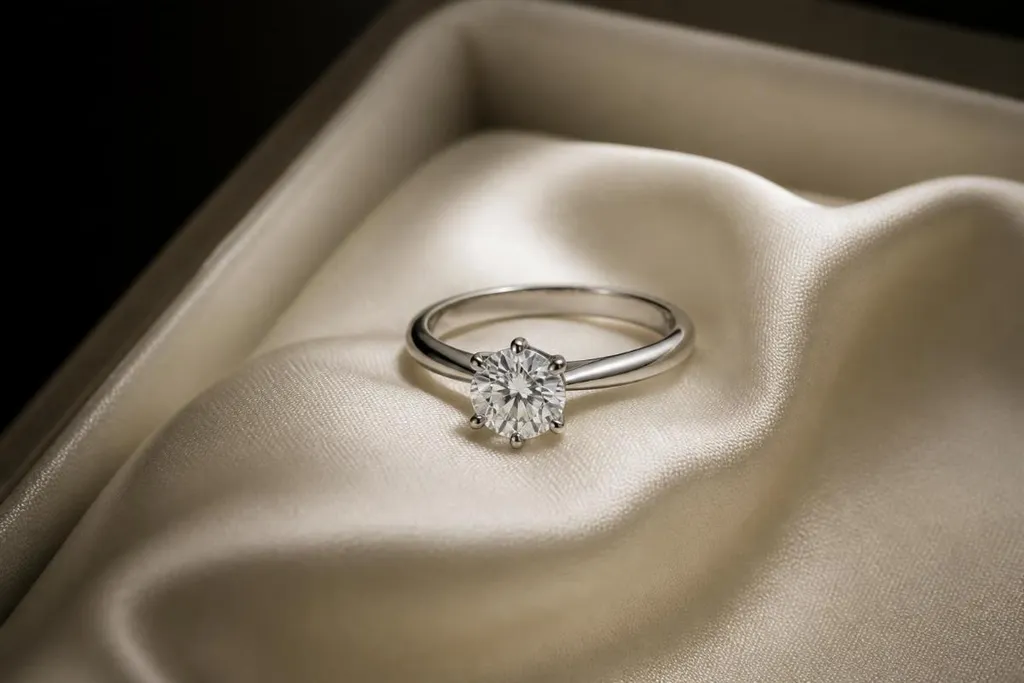
An engagement ring is expected to withstand a kind of wear that most fine jewellery never encounters. It may be worn from morning until night, exposed to desks, door handles, clothing, hand washing and countless small knocks. For that reason, the metal surrounding the centre stone deserves as much practical consideration as the design itself.
Platinum has long been valued for precisely this combination of refinement and resilience. Choosing hallmarked platinum engagement rings also provides an opportunity to consider something distinctly relevant to British jewellery: independent hallmarking of precious-metal fineness. Beyond its naturally white appearance, platinum offers density, durability and a distinctive way of aging that makes it particularly well suited to engagement rings intended for decades of wear.
What Does a Platinum Hallmark Tell You?
In the UK, hallmarking provides independent verification of precious-metal content for items that fall within the legal requirements. Rather than relying solely on a retailer's description, the marks applied to a piece provide information about its tested fineness and origin of hallmarking.
For platinum jewellery, a fineness mark such as 950 indicates that the alloy contains 950 parts platinum per thousand. Other elements may be incorporated into the alloy to give the metal the characteristics required for jewellery manufacture.
A complete UK hallmark can include several components, including a sponsor or maker's mark, the metal fineness mark and the mark of the assay office responsible for testing and hallmarking the piece.
These tiny symbols are easy to overlook, yet they offer meaningful reassurance when buying a piece as significant as an engagement ring. They provide an independently applied record of what the precious metal is represented to be.
Why Platinum Works So Well for Engagement Rings
Platinum has a naturally white colour, which makes it particularly attractive for engagement rings featuring colourless diamonds, lab-grown diamonds or pale gemstones. Unlike metals whose white appearance may rely on surface plating, platinum's underlying colour is itself white.
Its density is immediately noticeable as well. A platinum ring often feels reassuringly substantial in the hand compared with an otherwise similar design made from a less dense metal. Some people actively enjoy this weight because it gives fine jewellery a sense of permanence.
Durability is another advantage, although it is important to understand what that means. Platinum can still scratch. No precious metal worn daily will remain untouched indefinitely. The difference lies partly in how platinum responds to wear: rather than simply losing material with every mark, the metal can be displaced across the surface.
This characteristic is one reason platinum has traditionally been used for settings designed to secure valuable centre stones.
Understanding Patina and Everyday Wear
A newly finished platinum engagement ring has a bright, polished surface. Over time, regular contact with everyday objects creates fine marks that gradually develop into what jewellers describe as a patina.
Some wearers love this softer finish because it gives the ring a distinctive, lived-in character. Others prefer the brighter appearance of freshly polished platinum. Neither preference is wrong, and professional refinishing can restore a more polished surface when desired.
Routine care is relatively straightforward. Removing the ring for activities likely to cause unnecessary impact or abrasion—such as heavy manual work—is sensible. Household chemicals and accumulated lotions can also dull the appearance of the setting and stones, making gentle cleaning worthwhile.
Periodic professional inspection is particularly useful for engagement rings. A jeweller can examine claws and other setting components for wear while checking that the centre and accent stones remain secure.
Choosing Platinum With the Complete Ring in Mind
Platinum's cool tone works with an exceptionally broad range of engagement ring styles. It can make a solitaire feel crisp and understated, complement the geometry of an emerald or Asscher cut, or provide a discreet backdrop for pavé and halo settings.
Its strength and density can also influence how delicate details are engineered. Fine claws and intricate settings still need appropriate dimensions, but platinum allows designers to create refined structures intended for regular wear.
Think ahead to the wedding ring as well. Many couples prefer matching metals so that the two rings wear in a similar manner where their surfaces meet. The width, profile and finish of both rings can then be considered as one composition.
Final Thought
Platinum engagement rings offer more than a cool white appearance. Hallmarking can provide independent assurance of precious-metal fineness, while platinum itself brings density, durability and a distinctive patina that develops through everyday wear.
It should not be regarded as indestructible; an engagement ring still benefits from sensible care and occasional professional inspection. Yet for someone seeking a precious metal that combines understated elegance with long-term practicality, platinum remains an exceptionally considered choice.